The Flood Behind the Wall
The rains are coming, and the flood plans do not mention prisons. I looked for a plan for people in custody and I did not find one. This piece sets out what I found, what nobody has written down, and what must happen before the water rises.
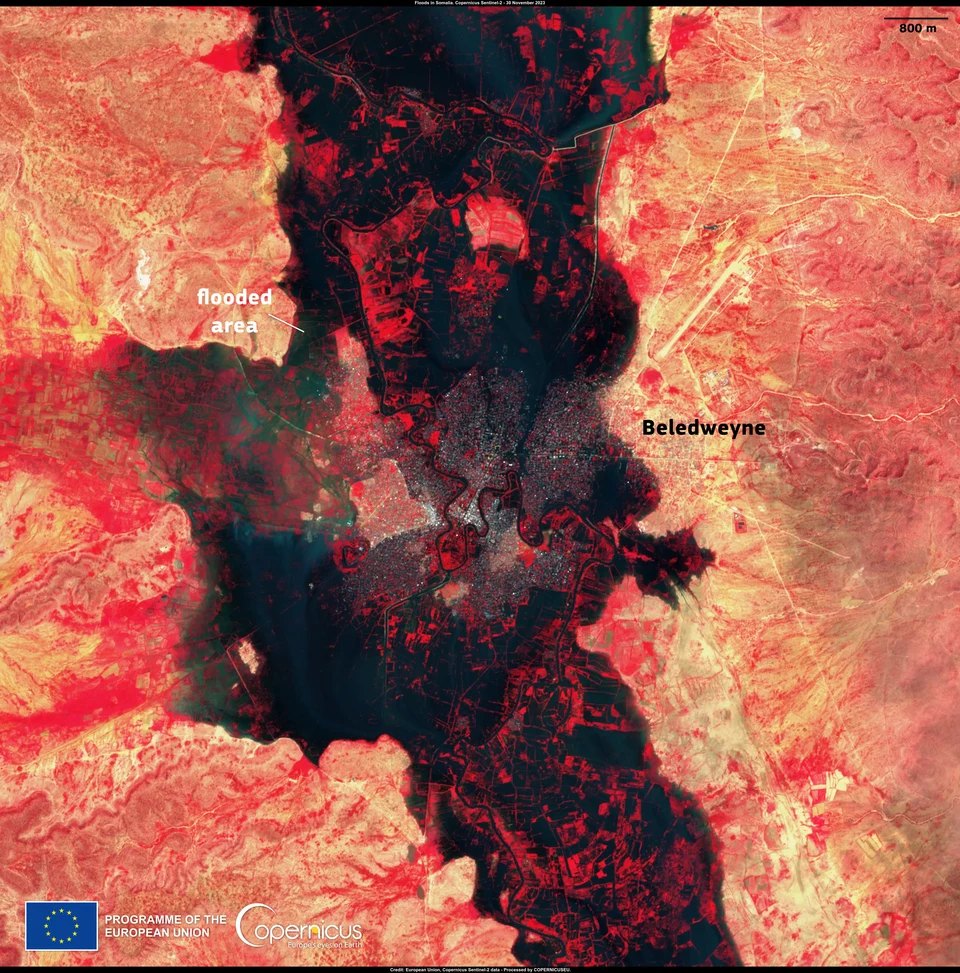
There is a prison in Beledweyne that sits beside a river. A July 2024 report by the UN mission in Somalia (UNSOM) says it floods easily (UNSOM, Prison Conditions in Somalia, July 2024). In May 2023, up to 85 percent of Beledweyne went under water and about 250,000 people fled (Islamic Relief via ReliefWeb). I could not find one public account of what happened to the people inside that prison.
That gap is what this piece is about. People in a cell cannot walk to higher ground. Whether they are moved, fed and treated depends on the prison authorities. And nobody outside may know that a decision was needed.
El Niño is a warming of the Pacific Ocean that changes the rain in East Africa. It is now firmly under way. On 3 September, the UN weather agency (WMO) said it is very likely to last through February 2027 and is forecast to grow very strong (WMO). The UN food agency (FAO) said in June that it was more than 90 percent likely to be present during the Deyr rains, the season from October to December (FAO Somalia). East Africa’s climate centre, ICPAC, gives a 90 percent chance of more rain than normal over central and southern Somalia (ICPAC).
A second pattern, the Indian Ocean Dipole, can add to the rain. In mid-August it sat at the edge of its positive stage and was likely to tip over. FEWS NET, a US-funded hunger warning network, expects a high chance of river floods and sudden floods after heavy rain. It warns of famine in parts of the south if the flooding is extreme, and it names 1997 and 2023 as the years to compare (FEWS NET, June 2026).
The UN disaster risk office (UNDRR) names the Jubba and Shabelle river valleys, home to about 8.8 million people, as the main area of concern. It expects river floods around Beledweyne, Bulo Burto, Jowhar, Luuq, Dollow and Bardheere. From October to March it expects sudden city floods in Mogadishu, Baidoa, Garowe, Kismayo and Jowhar (UNDRR).
The first rains have already come. Heavy rain in Mogadishu, through 16 September, caused sudden floods that stopped public transport. SoDMA, Somalia’s national disaster agency, put 29 districts in 14 regions on high alert (Hiiraan Online). They include Mogadishu, Baidoa, Kismayo, Beledweyne, Jowhar, Galkayo, Dhusamareb, Garowe, Bosaso, Qardho and Hargeisa (Dawan, reporting a SoDMA statement). Those are the towns where Somalia’s best-known prisons stand.
In August, the UN World Food Programme (WFP) estimated how many people live in areas that could flood (WFP VAM Somalia, Somalia El Niño 2026: Flood Exposure & Preparedness Analysis, August 2026). It says this season is running above a moderate flood year, with 2023 the closest match. In its middle scenario, about 1.7 million people live in areas that could flood. In a severe year that rises to 2.4 to 2.7 million. In an extreme year it is 3.4 to 3.7 million. WFP tells planners to prepare to help 800,000 to 1.2 million of them, the people likely to need aid. It says these are planning estimates, not a count of people who will need help.
Other estimates differ. SoDMA has said 2.5 to 3.5 million people could be exposed to floods, and about a million could be forced from their homes (WFP news release). A UN statement says more than 600,000 people are at risk (Xinhua). The numbers differ by source and method.
WFP finds most of the risk in the south. In its middle estimate, about 553,000 people live in flood areas in Bay, where Baidoa is. The other numbers are 199,000 in Hiraan, where Beledweyne is, 183,000 in Middle Shabelle, where Jowhar is, and 180,000 in Lower Jubba, where Kismayo is. In Beledweyne district alone, 160,000 to 180,000 people live in areas that could flood, and 85 settlements are in the highest risk class. WFP counts far fewer people around Mogadishu (about 21,000), Garowe (about 1,000), Bosaso and Qardho (about 260) and Hargeisa (about 1,000). But WFP warns that low numbers in high-risk districts do not prove safety. Sudden local floods are easy for its data to miss.
I could not check the ground level, drainage or flood history of most prisons. But the places at risk and the places that hold prisoners overlap a great deal.
After the 2023 floods, reports named the hospitals and schools that were hit. In Beledweyne and Galkayo, classrooms closed and hospital wards flooded (CNN; UN Media). Prisons and police cells do not appear in any of it.
This year’s plan has the same blind spot. The UN’s priorities are a shared national flood plan (officially, the anticipatory action framework), early warning, evacuation, water and health readiness, and help for displaced people (UNDRR). The UN’s emergency fund has set aside US$7 million for flood preparation. The UN’s 2026 aid plan for Somalia was only 29.7 percent funded in mid-August (Save the Children and partners).
I read the full 14-page UNDRR report. Its list of who is responsible names SoDMA, the environment and water ministries, the food-security monitors, the state disaster agencies, UN agencies and NGOs. It does not name the Ministry of Justice, the Custodial Corps (which runs the prisons) or the police. It never mentions prisons, police cells or detention. WFP’s August analysis does not either. The UNDRR report also says the shared flood plan and its warning levels were not finished when it was written.
I have not seen an internal emergency plan from the Ministry of Justice, the Custodial Corps or any regional authority. One may exist. If it does, it is not public, and the people it covers cannot ask for it.
The UNSOM report is the most specific source I found. It says the Beledweyne prison, beside a river, floods easily. It says Mogadishu Central Prison, near the sea, wears down faster because of salt (UNSOM). It also says the Beledweyne and Kismayo prisons have no clinic and no emergency medical supplies. The Custodial Corps has no vehicle to take a sick detainee to hospital and depends on the police.
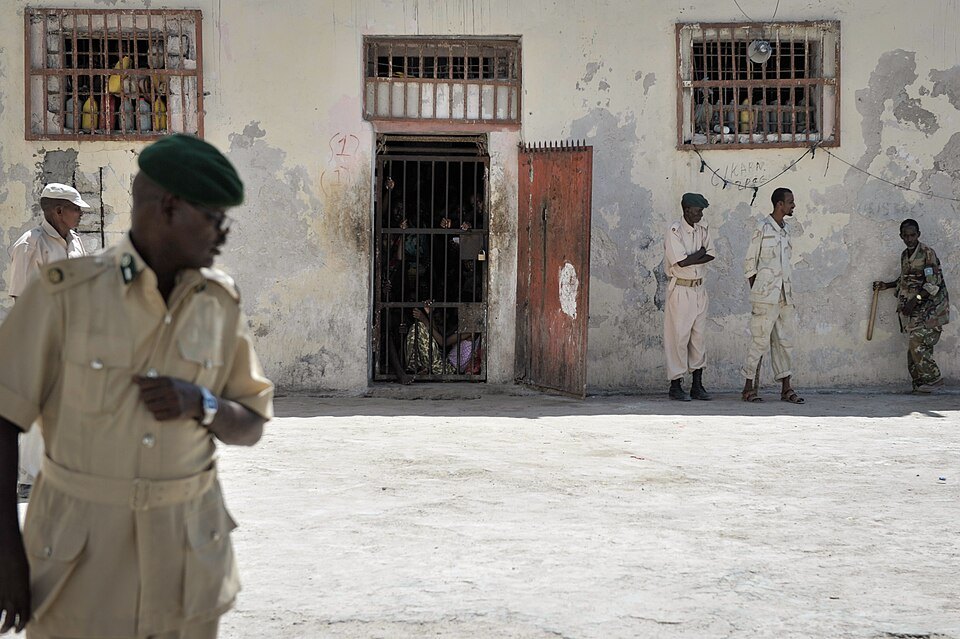
The US State Department’s 2020 report, citing the UN Office on Drugs and Crime, says several prisons run by the federal member states flooded often. Prisoners were moved to temporary sites, mostly police stations, until the water went down (US State Department, 2020). It names no prison, no date and no number. I found no other public account. Something that happens often to prisons left almost no record.
A police station is not a safe answer either. Reports describe crowded city prisons after big arrest operations, and people held before trial kept together with convicted prisoners in the south and centre (EU asylum agency (EUAA)). A move because of floods can push people from one crowded place to another, with less water, less food and less oversight.
UNSOM says food and water supply in most Somali prisons is inconsistent, mainly because there is not enough money. It also says floods and drought disrupt local food supplies and make it worse. It gives two examples.
- At Garowe Central Prison, Puntland’s Human Rights Defender found in July 2023 that the prison was short of food, electricity and water. The Custodial Corps had reportedly received no money for months because the Ministry of Finance had not released it. The Commissioner General said the prison’s borehole water was not fit to drink.
- At Baidoa prison, the food budget is a fixed daily amount, however many prisoners there are. Detainees get two meals a day. Shortages come from overcrowding and lack of money. A footnote elsewhere in the report puts food cash at about US$1.50 per detainee per day.
In Mogadishu, OPR’s 2025 report found a different set-up. Mogadishu Central Prison held 3,695 people: 2,590 convicted and 1,105 waiting for trial (OPR 2025 Annual Assessment). Family visits had been suspended for more than a year. Visitors who do get in cannot bring food, and they pay a US$20 fee. Prisoners buy food, and sometimes drinking water, from restaurants inside the prison that an inmate said belong to senior officials. A small plate of rice cost about US$1. One inmate told OPR: “We were instructed to pay monthly water charges. When we explained that we have no money and reminded them that we are the government’s responsibility, our concerns were dismissed.” In police stations it is the reverse. The government gives no meals there, and families bring the food. OPR’s 2024 report also documented food and water being sold inside (OPR 2024 Annual Assessment).
The State Department says families are usually expected to pay for health care, and that prisoners with no family or clan support get very little care (US State Department, 2023). Sahan, a security research group, reported the same in 2024, even for the three prisons believed to be better run (Sahan).
So who feeds a prisoner depends on the place. In the prison, it depends on what a detainee can pay. In police cells, it depends on what families can bring. A big flood hits both. In November 2023, floods on the Jubba damaged roads and swept away at least one bridge, cutting towns off (ReliefWeb flood advisory). Aid assessments reported destroyed markets, lost food stocks and rising prices in Beledweyne, Kismayo, Baidoa, Galkayo and Gedo (ACT Alliance, November 2023). Baidoa already held about 650,000 displaced people in 2023 (ABC News). If floods push more people into Baidoa and more detainees into its prison, a fixed food budget stretches thinner. That last step is my analysis. I found no published account of how the 2023 floods affected the food reaching detainees.
The State Department’s 2022 report said TB and cholera outbreaks continued in crowded prisons like Mogadishu Central, and warned they could be life-threatening in the rainy season (US State Department, 2022). Its 2023 report records the same outbreaks. UN-backed inspections in 2022 found TB, cholera and diarrhoea, cracked walls, old sewage systems and no showers (UNSOM).
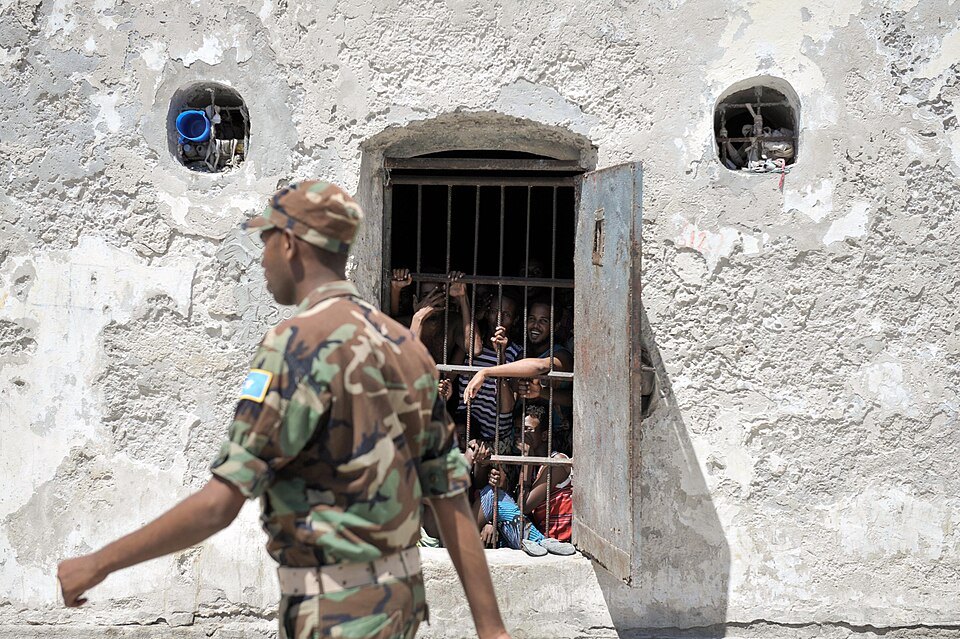
Floods add another danger, because dirty floodwater spreads disease. After 2023, aid assessments warned of outbreaks from contaminated water (ACT Alliance). This year the International Rescue Committee warned that heavy rain in the Ethiopian highlands, plus Deyr rain, could raise the rivers fast, foul water sources and raise the risk of cholera and watery diarrhoea (IRC). The WMO warns of more disease from water and mosquitoes across the region (WMO).
OPR’s 2025 report says TB and cholera outbreaks continue at the Mogadishu Prison and Court Complex, especially in the rainy season, and that there is no place to isolate TB patients. A doctor at De Martino Hospital told OPR that diarrhoea and cholera cases in Mogadishu’s prisons rose with the heat, with multiple deaths and 38 hospitalizations. He said TB is coming back (OPR 2025 Annual Assessment).
More heat is coming. The UNDRR report expects above-average temperatures from September, peaking between December and February in Puntland, Somaliland, Galmudug, the central regions and inland southern Somalia. Heat can also help disease spread (UNDRR). OPR’s 2025 report describes poor air and too much heat in the cells of Baidoa’s main jail (OPR 2025 Annual Assessment). Crowded cells, weak sanitation and a health system that depends on what families can pay: that is where these risks meet.
The last flood of this size was the 2023 Deyr flood. SWALIM, Somalia’s water and land information unit, had warned of a flood so large it should happen only once in a hundred years (VOA). The Red Cross (ICRC) says the rains began in mid-October 2023, with heavy flooding from 26 October, first along the Jubba and then the Shabelle. By 26 December the UN counted about 2.5 million people affected and 1.2 million forced from their homes. Jubaland and South West State were hit hardest. Roads were cut and two major bridges washed away (ICRC factsheet).
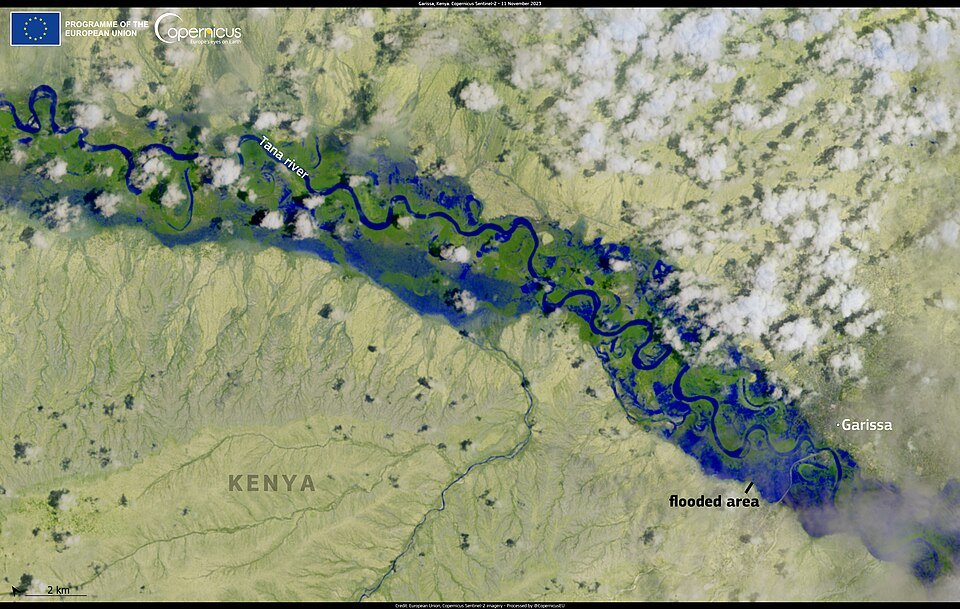
Two things from that time matter for detainees.
The national inspection programme sat idle. UNSOM says that in 2022 there were three announced inspections covering prisons in Mogadishu, Galkayo, Garowe, Bosaso, Qardho and Baidoa. In 2023, it says, no inspections were done, and there seemed to be no plan for lasting oversight (UNSOM). Other accounts differ. The ICRC visited 15 places of detention in 2023, up from 10 in 2022, and spoke with 4,495 detainees (ICRC). The State Department says authorities allowed the ICRC, UNICEF and the UN Office on Drugs and Crime to carry out joint inspections (US State Department, 2023). These may describe different things: a formal national round on one side, visits by international groups on the other. What UNSOM itself says is that the regular programme did not run in the year of a flood that forecasters had called a once-in-a-century event.
Supplies bought late arrive late. In late August 2023, the ICRC turned its whole Somalia programme to flood preparation and put existing work in the south on hold. Its factsheet does not say whether detention visits were paused. That is a question for the ICRC. The ICRC also found that six to eight weeks was not enough to buy and deliver many items, while medical supplies already stored in Somalia moved much faster (ICRC factsheet). The lesson is plain. Supplies for detainees must be bought now, not when the water rises.
In March 2024, the ICRC said fighting was expected to pick up after a lull caused by the rains at the end of 2023, and that it expected more people in detention (ICRC). Take that with care. Analysts at the conflict data group ACLED blamed the earlier drop in fighting in 2023 mainly on political disputes that paused the second phase of the government offensive (ReliefWeb/ACLED). West Point’s Combating Terrorism Center says the offensive stalled in 2023 and appears to have stopped between mid-October and November in central Somalia, without tying that to rain (CTC). The rains were probably one factor among several.
I found no public record of what happened to detainees in those weeks.
Every number in this piece is the least we can prove, not the total. OPR’s 2025 report counted 5,122 people in custody at 23 sites in Mogadishu: Mogadishu Central Prison, the Mogadishu Prison and Court Complex, Godka Jilacow prison, the Criminal Investigation Directorate (CID) and 19 district police stations. These are average numbers for the reporting period, from Ministry of Justice records and OPR surveys. The Godka Jilacow numbers are OPR’s own and not verified (OPR 2025 Annual Assessment). The count covers only people in recorded custody.
OPR believes many more people are held with no record. They are in CID cells, police cells and secret sites used by NISA, the national intelligence agency. The 2025 report describes NISA detention sites in ordinary houses in Mogadishu. It says OPR could not investigate them because NISA did not cooperate. Public sources point the same way. The State Department reports that federal police held people without a judge’s order, and that the government sometimes kept high-profile Al-Shabaab suspects in safe houses before charging them (US State Department, 2024).
There is a second problem. Families have told OPR that their sons and daughters disappeared after NISA allegedly detained them, and that they do not know where they are. Some detainees are kept in private homes. Human rights groups often cannot get into Godka Jilacow or the CID (OPR 2025 Annual Assessment). In some cases OPR knows a person was taken by NISA or the police, but the family does not know where that person is held. In its other reporting, OPR documents such cases as enforced disappearance, meaning a person held in secret with no word to the family (The Disappeared).
Because these people are in no register, nobody, including OPR, can say how many people are held in Somalia, whether convicted, waiting for trial or never brought before a court. For flood planning, that matters twice. A plan built on registers will not provide enough. And people whose custody is unrecorded, or whose families cannot find them, are the ones no one knows to move, feed or tell. A family that does not know where a relative is held cannot bring food or medicine. An authority with no record of a detainee cannot move that person to safety.
Prison security in Somalia is already under strain, apart from the weather. In July 2024, armed inmates at Mogadishu Central Prison tried to break out. A Custodial Corps spokesperson said five prisoners and three soldiers were killed and no prisoners escaped (Al Jazeera). In August 2024, Kaab TV reported that 12 Al-Shabaab prisoners escaped from a prison in north Galkayo and nine were recaptured (Kaab TV). In May 2025, an armed militia attacked a prison in the Puntland-run part of Galkayo, trying to free prisoners (EUAA). On 4 October 2025, Al-Shabaab attackers stormed the NISA-run Godka Jilacow prison in Mogadishu. The government said all seven attackers were killed. Reports differed on whether prisoners escaped and how many (Al Jazeera; Hiiraan Online). UNSOM says recent escapes and breakouts by Al-Shabaab militants show how much prison management and security matter.
The guard force is stretched. In March 2025, when Al-Shabaab launched its Middle Shabelle offensive, police and the Custodial Corps were sent to the front lines (EUAA). UNSOM’s inspectors also found very few staff in the prisons compared with the number of detainees, and prison management avoided giving them registered staff numbers (UNSOM). A flood, with guards pulled away, walls damaged and inmates moved between sites, is the kind of moment when order in a crowded prison can break.
Nigeria shows what can happen. In September 2024, flooding after the Alau Dam collapsed brought down walls at the Maiduguri prison (VOA). The Nigerian Correctional Service said 281 inmates went missing after being evacuated to another facility, and seven were recaptured (CNN). I am not saying Somalia will see the same. I am saying someone should plan for it.
This is where the least is known. I have not yet collected first-hand testimony from anyone held by Al-Shabaab during a flood, and I know of no published account.
What I can say comes from the surrounding record. Al-Shabaab holds people in its own detention places. OPR’s 2025 report describes them as overcrowded and lacking basics, including lighting, proper bedding and enough food, with very little contact with the outside world (OPR 2025 Annual Assessment). The US Treasury sanctioned a commander in Hisbah, the group’s religious enforcement unit, who ran a detention centre and handled detentions for the group’s courts. It also said that as recently as mid-2022 Al-Shabaab held more than 80 civilians in the Wayanta area of Lower Jubba, and that its Hisbah commander there refused to release them (US Treasury, 2023). The State Department’s report on 2024 says people held by Al-Shabaab were kept in inhuman conditions for small offences such as smoking, listening to music or playing soccer, and that the group blocked humanitarian aid (US State Department, 2024). For several years, State Department reports have said geography and insecurity make independent monitoring hard, and have described these sites as generally out of reach for international observers.
Control of territory matters. The International Crisis Group reports that Al-Shabaab regained most of Middle Shabelle and Hiraan in the first half of 2025, leaving the map of control close to where it was in 2022 (ICG, June 2026). Most of the group’s territory is rural. The EU asylum agency says it held most rural areas and many smaller towns in south-central Somalia as of March 2026 (EUAA). It holds land in every region the UN names as a flood danger zone, except Banadir, the Mogadishu region (UNDRR). All of Middle Jubba is theirs, including Jilib, Bu’aale and Saakow (EUAA). So is most of Bardheere district in Gedo (EUAA), and most of the land west of the Shabelle river in Hiraan (EUAA). I could not split the flood numbers between areas the group holds and areas the government holds, because no public data does that. The map I used is as of 31 March 2026 and may have changed.
The UN humanitarian office has mapped very heavy restrictions on aid in parts of Middle Shabelle (EUAA), and the US State Department says the group blocked humanitarian aid (US State Department, 2024). In my assessment, Al-Shabaab’s detention places are mostly in villages and rural land. I believe they are small, far from roads and clinics, and not prepared for floods. I found no public information on them, and no flood plan. This is my assessment, not a documented finding. If it holds, the people most at risk in a flood are also the people no independent observer can reach.
The 2023 floods give one lesson and one warning. The lesson: the ICRC did work in areas Al-Shabaab influences or controls, and about half of the 40,000 households it helped with protected water points lived there (ICRC factsheet). Contact is possible. The warning: Al-Shabaab agreed to ICRC help only after floods had made access impossible, which delayed shelter and hygiene kits. Access has to be asked for before the water rises. The International Crisis Group has also reported that Al-Shabaab uses access to water to control the people it governs (ICG, December 2024). Whether it does this to detainees, and how it treated them in past floods, is unknown. Former detainees, families and defectors need to be asked.
The risk and the information are not the same everywhere. This table shows what the public record says for each area. It does not rank who is safer.
| Area | Prisons named in public records | What the forecasts say | What is known |
|---|---|---|---|
| South and centre | Mogadishu Central Prison; Mogadishu Prison and Court Complex; Baidoa; Beledweyne; Kismayo | Most flood risk is in the south (Bay, Hiraan, Middle Shabelle, Lower Jubba). Sudden floods in Mogadishu. | Beledweyne prison floods easily. Beledweyne and Kismayo prisons have no clinic. Baidoa has a fixed food budget. TB and cholera at Mogadishu Central. Escape attempts and attacks in 2024 and 2025. |
| Puntland | Garowe; Bosaso; north Galkayo | UNDRR flags sudden floods in Garowe. WFP counts few people in flood areas (about 1,000 around Garowe, about 260 around Bosaso and Qardho) but says October to December will be wetter. Puntland’s climate centre gives a 65 percent chance of above-normal rain around Garowe, Galkayo and Qardho and 55 percent around Bosaso (IMC Puntland). Heat peaks from December to February. | Food, power and water shortages at Garowe in July 2023, with money reportedly not released. Drinking-water problem. A 2024 escape and a 2025 attack at north Galkayo prisons. |
| Somaliland | Hargeisa | The signals point both ways. The UN warns of worse drought in parts of Somaliland and of extreme heat from December to February. WFP counts about 1,000 people in flood areas around Hargeisa but says October to December will be wetter. Hargeisa is on SoDMA’s high-alert list. | Earlier US reports said Hargeisa Prison met international standards. In 2023 outside monitors were not allowed in. The UN prison report’s staffing figures leave out Somaliland. |
| Al-Shabaab areas | Not known publicly | The Jubba and Shabelle valleys are the main area of concern. | Detention is documented. No independent access. Flood effects unknown. |
Standards from earlier years may not describe today. Compare the State Department’s 2018 and 2023 reports on Garowe, and the UN’s 2024 findings, to see how much can change.
Survival in custody depends a lot on family and clan support. The prisoners with the least of both are the most exposed when a flood cuts supplies. My working idea is that prisoners from Somalia’s minority communities, including farming communities along the Jubba and Shabelle, are among them. Their families may be more likely to be forced from their homes and less able to call on clan networks. OPR’s minority prisoners’ department is well placed to test that.
This is analysis, not a measured result. I found no study of how floods affect detainees by community. It should be tested, not assumed.
The full recommendations are in OPR’s two companion briefs, Counting the Detained and Before the Rains. In short:
- Every disaster plan for the Deyr season should list places of detention as a vulnerable category, alongside hospitals and schools.
- Each prison and police cell should have a written flood plan: a risk check, a named alternative site, a way to record every detainee moved, and a way to tell families.
- Food, water, medicine and space to isolate sick people should be secured now. Do not leave it to families, and do not wait for a warning level to be hit. Goods bought late arrive late.
- Courts and prosecutors should review the cases of people held before trial and people held for minor offences now, so crowded prisons do not carry avoidable numbers into a flood.
- Independent monitors, including the ICRC and national human rights bodies, should have access before, during and after the flood. A regular national inspection programme should be put in place. UNSOM found none planned as of July 2024.
- Everyone held anywhere, including in CID, police and NISA sites, should be entered in a register, and their families told where they are. Without that, no flood plan can reach them.
If you were held in a Somali prison, police station or Al-Shabaab detention place during a flood in 2019, 2020, 2023 or another year, or if you are the family of someone who was, OPR wants to hear from you. You can tell us through the Testimonies page. Nothing is published without your clear consent. You can choose to be named, anonymous, or recorded for OPR’s records only.
I built this piece from public sources, each linked above. The Al-Shabaab territory information comes from the EU asylum agency’s control maps as of 31 March 2026. I read in full the UNSOM prison report, the ICRC’s 2023–24 El Niño factsheet, the UNDRR report and WFP’s August analysis. The State Department’s report on 2024 no longer has a prison-conditions section, so the latest State Department account I cite is its 2023 report.
I have not verified conditions inside any prison or police cell. I could not confirm which prisons other than Beledweyne’s are exposed to flooding, and I could not confirm what happened inside any prison in the 2023 floods. Where a point is my own analysis and not a documented finding, I have said so.
If you hold information that corrects or adds to anything here, write to me at [email protected].

How to cite this piece
Abukar, Ismail, for the Organization for Prisoners' Rights. (2026). The Flood Behind the Wall. Mogadishu: OPR. https://opr.org.so/news/the-flood-behind-the-wall/