When the Virus Reached the Cells: Somalia’s Prisons in 2020
- COVID-19 reached Somalia in March 2020 and reached a prison system with almost no capacity to protect the people inside it.
- The response depended heavily on outside agencies. The International Committee of the Red Cross (ICRC) and the UN Office on Drugs and Crime (UNODC) supplied soap, sanitiser, water and guidance; the government’s own measures were mostly closures and restrictions.
- Somaliland pardoned 574 low-risk prisoners on April 1 to ease overcrowding. It kept journalist Abdimalik Oldon in prison.
- On August 10, an armed attack inside Mogadishu Central Prison killed 19 people, after weapons were smuggled in two days earlier.
- I have found no published count of COVID-19 infections or deaths inside Somalia’s prisons for 2020. That absence is itself part of the record.
Somalia confirmed its first COVID-19 case in March 2020. By the end of April, the ICRC reported more than 500 confirmed cases, mostly in and around Mogadishu, and warned that the true number was likely higher. It described a health system gutted by decades of violence and underinvestment.
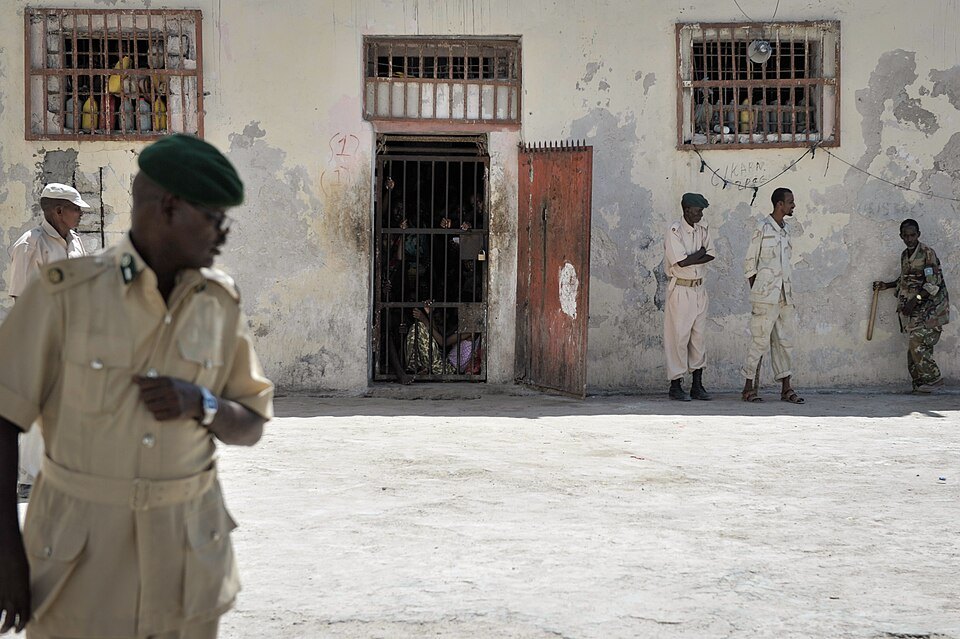
Inside detention facilities, the danger was structural. The ICRC listed overcrowding, shared sanitation, poor hygiene, limited ventilation and shared common areas as the conditions in which a highly infectious disease thrives, and noted that malnutrition and chronic illness among detainees made older and sick prisoners especially vulnerable.
The U.S. State Department’s report on 2020 described the baseline. Only inmates at Mogadishu Central Prison, the Mogadishu Prison and Court Complex, Garowe and Hargeisa had daily access to showers, sanitary facilities, adequate food and water, and outdoor exercise. Inmates elsewhere relied on family and clan for food and water. Families generally had to pay for health services, and prisoners without family or clan support had very limited access to them. The same report recorded continuing outbreaks of tuberculosis and cholera, particularly in overcrowded prisons.
The pandemic did not create these conditions. It arrived in them.
The most immediate change for prisoners was contact with the outside. In April 2020 the ICRC reported that some detention facilities had already halted family visits to reduce the risk, and that it was working with authorities to help detainees keep in touch with families by phone.
The restriction was countrywide. On March 22, 2020, the commander of the Custodial Corps (the national prison service), General Mahad Abdirahman Adan, announced a ban on all external visits to correctional facilities, following a Ministry of Health directive, as Hiiraan Online and Somaliland Standard reported that day. Both described it as a two-week halt. My own information is that it was repeatedly extended. The ICRC then arranged telephone contact so that prisoners could reach their families. I have not found a published copy of the directive, only news reports of the announcement, and I have found no public announcement of when the ban ended.
Visits matter in Somalia’s prisons for reasons that go beyond morale. Many inmates depend on relatives for food, medicine and money. When visits stop, so does that supply. I could not find published data on how many facilities suspended visits, for how long, or whether phone contact replaced the food and support that visits carried.
The clearest evidence of a response is from international agencies. On April 27, UNODC, with funding from the European Union and Sweden, delivered hygiene commodities and equipment to Mogadishu Central Prison, the Mogadishu Prison and Court Complex, and prisons in Garowe, Kismayo, Baidoa and Beledweyne: soap, wall-mounted soap and sanitiser dispensers, toothbrushes and toothpaste, plus new blankets, mattresses, mats and kitchenware. A follow-up statement in May said the support had reached more than 700 prisoners and appointed personnel and that UNODC had developed infection-control guidelines for prison officers with UN partners.
UNODC’s donation also included recreational and religious materials to offset pandemic-related visit restrictions, according to OPR’s August 2022 situation report. For scale, the same statement described Baidoa Central Prison as holding 127 inmates and 60 prison staff. The donations were real and useful. They were also a response to a system that could not have supplied basic hygiene itself.
The ICRC installed handwashing stations and briefed detainees and staff. A prisoner at Mogadishu Central Prison told the ICRC he had attended a hygiene talk and been shown how to wash his hands. This was useful guidance. It was not distancing, testing, isolation or treatment, none of which was possible in cells at that density.
Somaliland took the one step that directly reduces risk in an overcrowded prison: it released people. On April 1, 2020, President Muse Bihi Abdi pardoned 574 prisoners, and his office said those released were low-crime, non-threatening inmates.
The release did not reach everyone in detention for political reasons. Amnesty International noted that journalist Abdimalik Muse Oldon, arrested a year earlier for criticising the president on Facebook, was not freed. A pandemic measure that spares low-level offenders while keeping critics behind bars shows whose detention the state treats as negotiable.
Enforced detention did not pause for the pandemic. The journalist Mohamed Abdiwahab Nur, known as Abuja, was arrested by Somalia’s National Intelligence and Security Agency (NISA) on March 7 and held for three months with no contact with the outside world. With family visits curtailed in some facilities, those held outside the ordinary legal process had even fewer people able to find out where they were.
The deadliest event in Somalia’s prisons in 2020 was not the virus. On August 10, al-Shabaab inmates at Mogadishu Central Prison opened fire on guards. The prison authorities’ spokesman said 15 prisoners and four wardens died, and eight people were injured. A security official said the shooting began in the section holding inmates on life sentences and that the weapons were believed to have been hidden in food and other items brought in during visits, which were then taking place twice a week. I have not found an official record of when the March restrictions ended or when visits resumed.
An inquiry committee appointed by the acting prime minister found that pistols, ammunition and hand grenades were smuggled into the prison on August 8. At least 12 officers, six civilians and nine inmates were arrested, and the prison warden was dismissed. The police force in charge of prisons suspended the warden and reported the death toll as 19.
Early reports gave lower figures: Anadolu reported at least 11 dead on the day, and the toll rose as bodies were counted. The official figures came only from the prison authorities.
The attack shows what a closed, poorly searched, poorly supervised prison looks like under strain. Weapons entered through a routine that was supposed to be controlled, and the dead included guards as well as inmates.
By the end of 2020, three things were clear.
First, prisons had been protected, where they were protected at all, by donors and by a small number of releases rather than by state investment. Second, the measures that reduced risk were the ones that cost the state little: hygiene talks, closures and restrictions. Third, no public data existed on how the virus moved inside detention. I have not found any published count of infections, hospitalisations or deaths in Somalia’s prisons for 2020. Prisoners were counted when they were released or killed, but not when they were sick.
The next report in this series covers 2021, when the pandemic continued, visits were suspended again in parts of the country, and more prisoners were released.
OPR calls for the publication of COVID-19 infection, testing and mortality data for every prison and detention facility in Somalia and Somaliland; the release of elderly, sick and low-risk detainees during any future health emergency, applied without political exclusions; restoration of family contact and food supply as a right that continues during health emergencies; independent medical staff and isolation space in every prison; and full, published accounts of how weapons entered Mogadishu Central Prison in August 2020, and who was held responsible.

How to cite this piece
Abukar, Ismail, for the Organization for Prisoners' Rights. (2020). When the Virus Reached the Cells: Somalia’s Prisons in 2020. Mogadishu: OPR. https://opr.org.so/news/covid-prisons-2020/